 By Lawrence Perez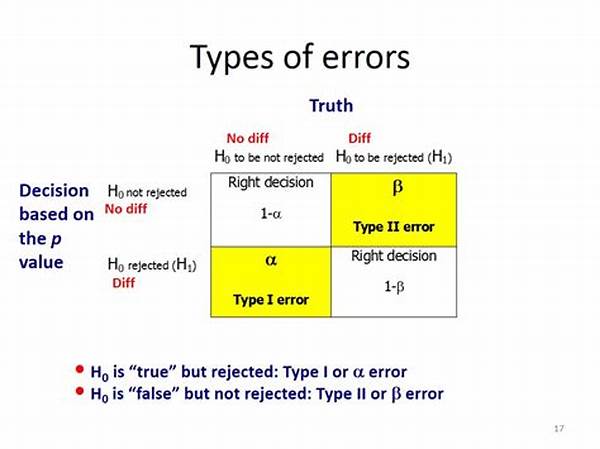
 0
0
 0
0
Hypothesis testing serves as a cornerstone of inferential statistics, enabling researchers to draw conclusions about populations based on sample data. In the process of hypothesis testing, two primary types of statistical errors may arise—Type I and Type II errors. These errors can significantly influence the outcome of research by leading to incorrect conclusions, thus underscoring the importance of understanding their nature and implications. Types of errors in hypothesis testing reveal critical insights into the reliability and validity of statistical conclusions. In the following, we will delve into each type of error and the potential impact they hold in research contexts.
Read Now : Academic Writing Tone Examples
Understanding Type I and Type II Errors
Type I errors occur when a true null hypothesis is incorrectly rejected. This error is often considered more serious, as it leads to a false positive result, suggesting the presence of an effect or difference when none exists. The probability of committing a Type I error is denoted by alpha (α), commonly set at 0.05, implying a 5% risk of incorrectly rejecting the null hypothesis.
Conversely, Type II errors take place when a false null hypothesis is not rejected. This type of error leads to a false negative result, suggesting the absence of an effect or difference when one actually exists. The probability of committing a Type II error is represented by beta (β). An effective research design aims to minimize both types of errors in hypothesis testing to ensure more accurate and reliable results.
The balance between these errors is crucial, as efforts to reduce one typically increase the other. Thus, researchers must make informed decisions about acceptable levels of risk for each error, based on the specific context and consequences associated with the study. By maintaining a strategic approach, researchers can effectively navigate the challenges posed by types of errors in hypothesis testing.
Specific Examples of Errors
1. Type I Error Example: Concluding a new drug is effective when it is not.
2. Type II Error Example: Failing to detect the effectiveness of a genuinely beneficial treatment.
3. Significance Level: The threshold probability set for Type I errors in hypothesis testing.
4. Power of a Test: The probability of correctly rejecting a false null hypothesis, related to Type II errors.
5. Confidence Intervals: Provide estimates that help assess the plausibility of errors in hypothesis testing.
Implications for Research
The types of errors in hypothesis testing hold considerable implications for scientific research. Type I errors can undermine the credibility of scientific findings by producing results that mislead both researchers and the public. These errors can waste resources and efforts by promoting ineffective treatments or interventions based on inaccurate data. Consequently, safeguarding against Type I errors requires vigilance in setting an appropriate significance level and ensuring rigorous research methodologies.
Type II errors, while seemingly less critical, also carry noteworthy ramifications. The failure to identify genuine effects can stall scientific progress and innovation. It may lead to missed opportunities for groundbreaking discoveries or improvements in practice. To mitigate Type II errors, researchers can increase the sample size, refine experimental design, or enhance measurement precision, thereby boosting the power of their tests and reducing the incidence of such errors. Ultimately, understanding the types of errors in hypothesis testing is essential for rigorous and effective scientific inquiry.
Mitigating Error Occurrence
1. Adequate Sample Size: Ensures more reliable estimates and reduces errors.
2. Proper Test Selection: Use of appropriate statistical tests to match the study’s design.
3. Rigorous Methodology: Implementation of standardized protocols to decrease error probabilities.
Read Now : Detecting Bias In Academic Literature
4. Conservative Significance Levels: Lower alpha levels to reduce Type I error risk.
5. Increased Statistical Power: Strategies to reduce Type II errors by enhancing test sensitivity.
6. Repeated Testing: Re-evaluation of results across multiple studies to confirm findings.
7. Control for Confounding Variables: Addresses external factors that may introduce errors.
8. Comprehensive Data Collection: Ensures all relevant data to minimize informational gaps.
9. Peer Review: Independent assessment of research to catch potential errors.
10. Transparent Reporting: Full disclosure of methodology and results to identify and rectify errors.
Conclusion of the Errors in Hypotheses
In conclusion, types of errors in hypothesis testing are indispensable considerations for researchers seeking to derive valid and reliable conclusions. A comprehensive understanding and management of Type I and Type II errors enhance the integrity and impact of scientific investigations. By carefully designing studies and planning analyses, researchers can minimize the likelihood and consequences of these errors.
It is essential for researchers to remain vigilant about the potential for errors in hypothesis testing, given the ramifications for both academic progress and practical applications. Whether through careful planning, robust methodologies, or methodological transparency, the quest for minimizing types of errors in hypothesis testing remains a central task for the scientific community. Researchers must continue to explore strategies to improve hypothesis testing frameworks and contribute to the advancement of knowledge with confidence and precision.
Final Thoughts on Managing Errors
Hypothesis testing remains a powerful tool for contributing insightful results to scientific endeavors. Yet, its efficacy largely depends on the awareness and management of types of errors in hypothesis testing. By nurturing a profound understanding of errors, researchers can proactively guard against erroneous conclusions and reinforce the overall quality of scientific research.
Considerable effort has been devoted to developing advanced statistical techniques and tools to aid researchers in effectively navigating the complexities of hypothesis testing. Continued innovation in this area will undoubtedly further empower researchers in mitigating the occurrence and impact of errors in hypothesis testing, thereby allowing the generation of more reliable and impactful scientific knowledge.


