 By Lawrence Perez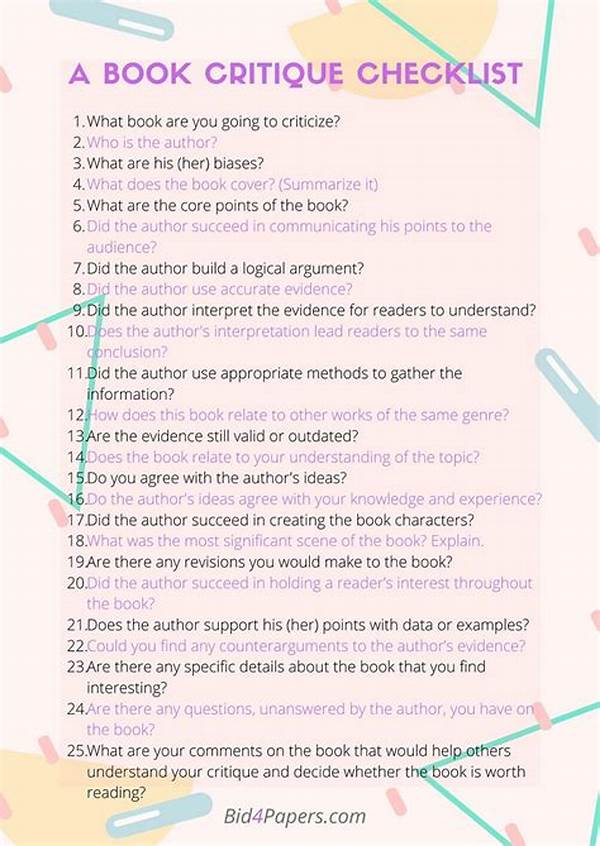
 0
0
 0
0
In the realm of academia, the process of critiquing books demands not only comprehensive understanding but also adherence to recognized standards. Academic book critiques are integral to scholarly discourse, serving as a medium to evaluate, interpret, and challenge the arguments presented within academic texts. To ensure the critiques maintain a high level of intellectual rigor, certain standards have been established and widely accepted across academic fields.
Read Now : Enhancing Efficiency With Citation Management
The Importance of Standards for Academic Book Critiques
Academic book critiques play a pivotal role in literature and research evaluation. These critiques not only facilitate an understanding of the book’s contributions to its respective field but also scrutinize the methodologies and theoretical frameworks employed. Adhering to standards for academic book critiques ensures that the analysis is systematic, objective, and constructive.
The standards for academic book critiques typically encompass an in-depth evaluation of the book’s argument structure, the credibility of its sources, and the authority of the author. A critic should thoughtfully examine whether the book contributes to existing research and whether its arguments uphold the standards of logical soundness and empirical reliability. Furthermore, critiques adhering to these standards often incorporate a balanced perspective, acknowledging the strengths while candidly addressing the book’s limitations and areas for improvement.
Maintaining these standards is crucial for the credibility of both the critique itself and the broader academic discourse it engages. In particular, these standards encourage critics to engage critically and independently with texts, facilitating ongoing dialogues between scholars about the value, applicability, and future influence of a work within its field. The integrity upheld by these standards reinforces the value of academic book critiques as instruments for scholarly enhancement and intellectual exploration.
Key Elements in Standards for Academic Book Critiques
1. Comprehensive Analysis: A thorough examination of the text ensures all arguments are scrutinized, contributing to a well-rounded critique. Adhering to standards for academic book critiques demands this depth of analysis.
2. Objective Assessment: These standards require the critique to maintain impartiality, evaluating the book’s strengths and weaknesses fairly.
3. Methodological Evaluation: Assessing the research methods used in the book and their effectiveness is crucial to meet standards for academic book critiques.
4. Theoretical Relevance: Evaluators should consider the text’s contribution to existing theoretical debates, aligning their critique with established standards for academic book critiques.
5. Constructive Feedback: The critique should offer insights on how the book’s arguments might be improved, following standards for academic book critiques.
Challenges in Adhering to Standards for Academic Book Critiques
Adhering to standards for academic book critiques can be a challenging endeavor due to several factors. One significant challenge is the need for comprehensive expertise in the subject matter. Critics are expected to possess a deep understanding of the field to accurately assess the book’s claims. This requirement often necessitates extensive background research, making the critique process time-consuming.
Additionally, maintaining objectivity can be difficult, particularly if the critic has preconceived notions about the topic or the author. To address this, critics should strive to be self-aware of their biases and ensure that their critiques are grounded in factual analysis and logical reasoning. The standards for academic book critiques emphasize the necessary separation of personal opinions from scholarly evaluation.
The dynamic nature of academic research also presents a challenge. As new theories and methodologies continue to evolve, critics must stay abreast of current trends in order to contextualize their critiques appropriately. Continuous learning and adaptation are imperative for upholding the standards for academic book critiques, thereby ensuring critiques remain relevant and authoritative in an ever-changing academic landscape.
Detailed Analysis within Standards for Academic Book Critiques
To produce a critique that meets the standards for academic book critiques, a detailed analysis is required. This entails breaking down complex arguments to evaluate their coherence and consistency. Critics should examine the logical flow of ideas, ensuring that each claim is substantiated with empirical evidence. Furthermore, the critique should assess the significance of the book’s contributions to its field, determining whether it introduces novel insights or reaffirms established knowledge.
Another essential aspect of detailed analysis involves evaluating the book’s structure and presentation. The standards for academic book critiques underline the importance of clear and concise communication. Critics should assess whether the author effectively communicates their ideas and whether the book is organized in a manner that facilitates understanding. This aspect of the critique not only reflects the quality of the writing but also its accessibility to the intended audience.
Critical analysis should also consider the book’s engagement with existing literature. A comprehensive critique evaluates how the book dialogues with previous scholarship and whether it situates itself within ongoing academic debates. This level of analysis aligns with the standards for academic book critiques, which demand that critiques consider the broader academic context and the book’s impact within it.
Application of Standards for Academic Book Critiques
The application of standards for academic book critiques is a fundamental practice within the realm of scholarly evaluation. These standards are applicable across disciplines, providing a framework for rigorous and methodical assessment. Critics who adhere to these standards ensure that their critiques are not only informative but also enhance the quality of academic discourse.
One of the primary applications of these standards is to facilitate the synthesis of multifaceted arguments presented in books. By methodically breaking down these arguments, critiques can provide clarity and insight for readers, offering an overview that aligns with the structured approach advocated by the standards for academic book critiques.
These standards also play a crucial role in fostering critical thinking. By requiring critics to engage with texts critically and independently, the application of these standards encourages deeper intellectual engagement. Critics are prompted to question assumptions, challenge established notions, and propose alternative interpretations, all while enhancing the discourse with constructive feedback.
Read Now : Emotional Intelligence And Leadership Skills
In summary, the standards for academic book critiques serve as a cornerstone for scholarly evaluation, ensuring critiques are both comprehensive and impactful. Their application is vital in maintaining the integrity and advancement of academic inquiry, promoting a robust and vibrant scholarly community.
Framework for Effective Critiques in Standards for Academic Book Critiques
1. Comprehensive understanding of the subject matter is essential to deliver effective critiques that meet the standards for academic book critiques.
2. Objectivity and impartiality are paramount for providing balanced evaluations in line with these standards.
3. Evaluations should emphasize both theoretical and practical contributions of the book to align with the standards for academic book critiques.
4. Critiques should provide constructive insights and suggest potential improvements, adhering to standard expectations.
5. Efficient organization and clear communication are integral for critiques that comply with these academic standards.
6. Engaging with existing literature is crucial for situating the critique within broader academic debates.
7. Critics must strive to remain informed of current and evolving trends within their field, ensuring the applicability of their critique.
8. Awareness of personal biases and their potential impact is necessary to maintain objectivity in critiques.
9. Critical thinking skills are essential for dissecting arguments and providing insightful analyses, meeting set standards.
10. Continuous learning and adaptation are required to meet the ever-evolving criteria in standards for academic book critiques.
Conclusion on Standards for Academic Book Critiques
The adherence to standards for academic book critiques underscores the importance of maintaining intellectual accountability and rigor. These standards cultivate an environment in which scholarly evaluation is not only systematic but also equitable, permitting critics to engage deeply with texts. Through these critiques, new insights emerge, contributing to the ongoing development of academic fields.
These standards also highlight the critical role of constructive criticism within the scholarly community. Through thoughtful engagement with academic texts, critiques can serve as a catalyst for innovation and advancement. By drawing attention to both strengths and weaknesses, critics encourage authors and researchers to refine their ideas and methodologies, fostering continued scholarly growth.
In essence, the standards for academic book critiques function as a guiding framework that upholds the integrity and quality of academic analyses. By promoting objectivity, depth, and engagement, these standards ensure critiques remain valuable resources for scholars and students alike, enriching the pursuit of knowledge and the process of scholarly inquiry.


