 By Lawrence Perez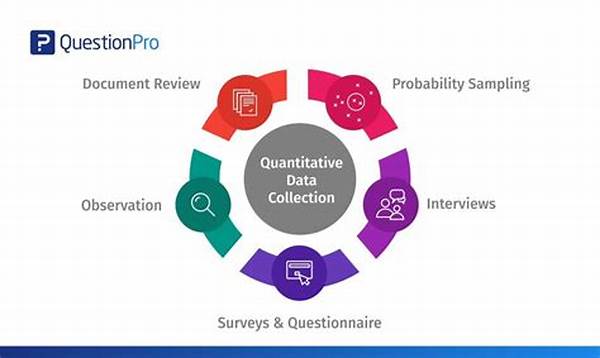
 0
0
 0
0
In the realm of research, the ability to gather accurate and objective data is crucial. Among the myriad methodologies available, quantitative data collection approaches stand out for their empirical nature and capacity for statistical analysis. As a cornerstone of scientific inquiry, these approaches allow researchers to quantify variables and make informed deductions based on numerical data.
Read Now : Critical Review Of Research Evidence
The Importance of Quantitative Data Collection
Quantitative data collection approaches are vital for ensuring that research findings are both reliable and valid. These methods enable researchers to collect data that can be quantified, thus offering an objective basis for evaluating hypotheses. By utilizing structured tools like surveys, questionnaires, and instruments that provide statistical metrics, researchers can minimize bias and increase the reliability of their findings. Furthermore, quantitative approaches allow for the generalization of results to broader populations, provided that sampling methods are appropriately applied. This generalizability is a key advantage in fields where drawing broader conclusions is essential.
The specificity and precision inherent in quantitative data collection approaches also afford researchers the ability to perform detailed statistical analyses. This enables the detection of patterns, relationships, and trends within the data, thus enriching the research output and facilitating the development of evidence-based recommendations. By translating real-world phenomena into numerical data, researchers can apply mathematical frameworks to evaluate variables of interest, providing a robust foundation for theory testing and development.
Moreover, quantitative data collection approaches facilitate comparative analysis across different studies and demographics. When consistent methodologies are applied, data collected from diverse settings can be compared and contrasted, furthering our understanding of global trends and localized variations. This consistency is pivotal for cross-disciplinary studies and international collaborations, where cohesive data collection methods are essential for coherent analysis and interpretation.
Key Methods in Quantitative Data Collection
There are several prominent quantitative data collection approaches that researchers frequently utilize:
1. Surveys and Questionnaires: These tools gather data from large samples, allowing for statistically significant conclusions.
2. Structured Interviews: Through standardized questions, they provide uniformity in data for comparison and statistical analysis.
3. Observational Methods: In controlled settings, they allow for precise data collection relevant to specific variables.
4. Experiments: These are critical for testing hypotheses and determining causal relationships, facilitated by controlled variables and environments.
5. Secondary Data Analysis: This method leverages existing datasets to offer new insights and expand upon previous findings.
Advantages and Challenges of Quantitative Data Collection
Quantitative data collection approaches offer numerous advantages, including the ability to quantify variables, aiding in the empirical testing of hypotheses. This numerical approach allows researchers to apply statistical analysis techniques to evaluate the significance and correlations within the data. Consequently, the conclusions drawn are often more objective and replicable compared to qualitative methods.
Read Now : Classroom Activities Promoting Family Participation
However, quantitative methods also come with challenges. Designing effective instruments that accurately capture the data needed without introducing bias can be complex. Researchers must ensure that their instruments are valid and reliable, addressing any potential sources of error. Moreover, while quantitative methods excel at showing correlations, they can sometimes fall short in explaining the underlying reasons behind observed patterns. To mitigate this, researchers often complement these methods with qualitative approaches, providing a more comprehensive understanding of the phenomena under study.
Despite these challenges, the utility of quantitative data collection approaches in research is undeniable. By enabling the precise measurement and analysis of variables, these methods continue to be integral in advancing scientific knowledge across disciplines.
Applications in Various Research Fields
Quantitative data collection approaches find applications across numerous fields. In the social sciences, these methods are crucial for conducting large-scale surveys that inform public policy decisions. In health sciences, clinical trials rely on quantitative data to assess the efficacy of new treatments. Similarly, in economics, these approaches enable the analysis of market trends and consumer behavior, providing insights critical for businesses and policymakers alike. Educational research also benefits from quantitative methods, allowing for the evaluation of program effectiveness and student performance. The versatility and robustness of these approaches ensure their continued relevance and efficacy in advancing knowledge across diverse domains.
Examining the Future of Quantitative Data Collection
The evolution of technology poses promising advancements for quantitative data collection approaches. With the advent of digital tools, data can now be collected in real-time, leading to more dynamic analyses. Innovations such as machine learning and artificial intelligence provide new opportunities for data processing, enabling the handling of vast datasets with increased efficiency and precision. These technological integrations are poised to enhance the capabilities of traditional quantitative methods, offering deeper insights and more nuanced interpretations.
Furthermore, the increased connectivity and availability of big data are paving the way for more comprehensive research initiatives. Quantitative data collection is set to benefit from these developments, as researchers gain access to a broader spectrum of data sources. This evolution will likely spur new methodologies and frameworks, further refinement of existing approaches, and an overall expansion of the scope of quantitative research.
Ethical Considerations in Quantitative Research
As with any research endeavor, ethical considerations play a crucial role in the implementation of quantitative data collection approaches. Ensuring participant confidentiality and informed consent are paramount in maintaining the integrity of research practices. Moreover, researchers must remain vigilant in addressing potential biases and ensuring the fair representation of populations within their studies. Adhering to ethical standards not only protects participant rights but also upholds the credibility of research findings.
In summary, quantitative data collection approaches remain at the forefront of empirical research, enabling the precise and reliable gathering of numerical data. The continued evolution and refinement of these methods, supported by advancements in technology and a commitment to ethical practice, ensure their ongoing contribution to the expansion of knowledge and the advancement of societal progress.


